The Drivers Cooperative or Co-Op Ride is an American ridesharing company and mobile app that is a workers cooperative, owned collectively by the drivers. The cooperative launched in May 2021 in New York City, with the first 2,500 drivers issued their ownership certificates in a media event. The cooperative was co-founded by Grenadan immigrant and for hire vehicle driver Ken Lewis, labor organizer Erik Forman, and former Uber executive Alissa Orlando. Mohammad Hossen is the first member of the drivers' advisory board, which they plan to expand democratically as more drivers are onboarded. Other staff include software and industry veterans and in addition to co-founder Lewis, there are other drivers in management roles such as ex-driver and organizer David Alexis. The Co-Op Ride app is on the iOS and Android platforms and is built on Google Maps, Stripe, and Waze. By July, the app had been downloaded by 30,000 users and the number of drivers increased to 3,400, and by August there were 40,000 users. The cooperative is owned by the drivers themselves, and takes 15% from each ride for business overhead costs, as opposed to the 25% to 40% ride hail apps like Uber or Lyft take per ride. While being ultimately owned by the driver members, not by investors, the cooperative began with seed money from the Minnesota-based Community Development Financial Institution Shared Capital Cooperative, the local Lower East Side People's Federal Credit Union, and welcomed individual donations via crowdfunding in the form of revenue sharing debt on Wefunder. Each driver is a member of the cooperative and owns one share of the company and one vote in business and leadership decisions. In addition to a larger percentage of the fees per ride driven, each driver as a part-owner will also receive a share of the company's profits after loans and other expenses are paid, in the form of weighted dividends. The drivers use their own cars. The cooperative vets its owner-members further than what is already performed by the New York City Taxi and Limousine Commission (TLC), and gives a fixed price when a car is ordered and does not engage in surge pricing. The TLC imposed a minimum payrate for mobile app ridesharing companies operating in New York city in 2018. In 2021 that is $1.26 per mile which Uber and Lyft do not pay above; the cooperative pays a minimum mileage of $1.64. The cooperative intends to be able to set aside 10% of profits to community foundations and other non-profits and community organizations. The cooperative has engaged in advocacy around a policy agenda voted on by its members. Legislation to achieve this policy goal was introduced by State Senator Julia Salazar and Assemblymember Jessica González-Rojas, with the support of a coalition led by The Drivers Cooperative, United Auto Workers Region 9 and 9A, Sunrise Movement, New York Lawyers for the Public Interest, and New York Communities for Change.
Visual temporal attention
Visual temporal attention is a special case of visual attention that involves directing attention to specific instant of time. Similar to its spatial counterpart visual spatial attention, these attention modules have been widely implemented in video analytics in computer vision to provide enhanced performance and human interpretable explanation of deep learning models. As visual spatial attention mechanism allows human and/or computer vision systems to focus more on semantically more substantial regions in space, visual temporal attention modules enable machine learning algorithms to emphasize more on critical video frames in video analytics tasks, such as human action recognition. In convolutional neural network-based systems, the prioritization introduced by the attention mechanism is regularly implemented as a linear weighting layer with parameters determined by labeled training data. == Application in Action Recognition == Recent video segmentation algorithms often exploits both spatial and temporal attention mechanisms. Research in human action recognition has accelerated significantly since the introduction of powerful tools such as Convolutional Neural Networks (CNNs). However, effective methods for incorporation of temporal information into CNNs are still being actively explored. Motivated by the popular recurrent attention models in natural language processing, the Attention-aware Temporal Weighted CNN (ATW CNN) is proposed in videos, which embeds a visual attention model into a temporal weighted multi-stream CNN. This attention model is implemented as temporal weighting and it effectively boosts the recognition performance of video representations. Besides, each stream in the proposed ATW CNN framework is capable of end-to-end training, with both network parameters and temporal weights optimized by stochastic gradient descent (SGD) with back-propagation. Experimental results show that the ATW CNN attention mechanism contributes substantially to the performance gains with the more discriminative snippets by focusing on more relevant video segments. == Literature == Seibold VC, Balke J and Rolke B (2023): Temporal attention. Front. Cognit. 2:1168320. doi: 10.3389/fcogn.2023.1168320.
Audio mining
Audio mining is a technique by which the content of an audio signal can be automatically analyzed and searched. It is most commonly used in the field of automatic speech recognition, where the analysis tries to identify any speech within the audio. The term audio mining is sometimes used interchangeably with audio indexing, phonetic searching, phonetic indexing, speech indexing, audio analytics, speech analytics, word spotting, and information retrieval. Audio indexing, however, is mostly used to describe the pre-process of audio mining, in which the audio file is broken down into a searchable index of words. == History == Academic research on audio mining began in the late 1970s in schools like Carnegie Mellon University, Columbia University, the Georgia Institute of Technology, and the University of Texas. Audio data indexing and retrieval began to receive attention and demand in the early 1990s, when multimedia content started to develop and the volume of audio content significantly increased. Before audio mining became the mainstream method, written transcripts of audio content were created and manually analyzed. == Process == Audio mining is typically split into four components: audio indexing, speech processing and recognition systems, feature extraction and audio classification. The audio will typically be processed by a speech recognition system in order to identify word or phoneme units that are likely to occur in the spoken content. This information may either be used immediately in pre-defined searches for keywords or phrases (a real-time "word spotting" system), or the output of the speech recognizer may be stored in an index file. One or more audio mining index files can then be loaded at a later date in order to run searches for keywords or phrases. The results of a search will normally be in terms of hits, which are regions within files that are good matches for the chosen keywords. The user may then be able to listen to the audio corresponding to these hits in order to verify if a correct match was found. === Audio Indexing === In audio, there is the main problem of information retrieval - there is a need to locate the text documents that contain the search key. Unlike humans, a computer is not able to distinguish between the different types of audios such as speed, mood, noise, music or human speech - an effective searching method is needed. Hence, audio indexing allows efficient search for information by analyzing an entire file using speech recognition. An index of content is then produced, bearing words and their locations done through content-based audio retrieval, focusing on extracted audio features. It is done through mainly two methods: Large Vocabulary Continuous Speech Recognition (LVCSR) and Phonetic-based Indexing. ==== Large Vocabulary Continuous Speech Recognizers (LVCSR) ==== In text-based indexing or large vocabulary continuous speech recognition (LVCSR), the audio file is first broken down into recognizable phonemes. It is then run through a dictionary that can contain several hundred thousand entries and matched with words and phrases to produce a full text transcript. A user can then simply search a desired word term and the relevant portion of the audio content will be returned. If the text or word could not be found in the dictionary, the system will choose the next most similar entry it can find. The system uses a language understanding model to create a confidence level for its matches. If the confidence level be below 100 percent, the system will provide options of all the found matches. ===== Advantages and disadvantages ===== The main draw of LVCSR is its high accuracy and high searching speed. In LVCSR, statistical methods are used to predict the likelihood of different word sequences, hence the accuracy is much higher than the single word lookup of a phonetic search. If the word can be found, the probability of the word spoken is very high. Meanwhile, while initial processing of audio takes a fair bit of time, searching is quick as just a simple test to text matching is needed. On the other hand, LVCSR is susceptible to common issues of speech recognition. The inherent random nature of audio and problems of external noise all affect the accuracies of text-based indexing. Another problem with LVCSR is its over reliance on its dictionary database. LVCSR only recognizes words that are found in their dictionary databases, and these dictionaries and databases are unable to keep up with the constant evolving of new terminology, names and words. Should the dictionary not contain a word, there is no way for the system to identify or predict it. This reduces the accuracy and reliability of the system. This is named the Out-of-vocabulary (OOV) problem. Audio mining systems try to cope with OOV by continuously updating the dictionary and language model used, but the problem still remains significant and has probed a search for alternatives. Additionally, due to the need to constantly update and maintain task-based knowledge and large training databases to cope with the OOV problem, high computational costs are incurred. This makes LVCSR an expensive approach to audio mining. ==== Phonetic-based Indexing ==== Phonetic-based indexing also breaks the audio file into recognizable phonemes, but instead of converting them to a text index, they are kept as they are and analyzed to create a phonetic-based index. The process of phonetic-based indexing can be split into two phases. The first phase is indexing. It begins by converting the input media into a standard audio representation format (PCM). Then, an acoustic model is applied to the speech. This acoustic model represents characteristics of both an acoustic channel (an environment in which the speech was uttered and a transducer through which it was recorded) and a natural language (in which human beings expressed the input speech). This produces a corresponding phonetic search track, or phonetic audio track (PAT), a highly compressed representation of the phonetic content of the input media. The second phase is searching. The user's search query term is parsed into a possible phoneme string using a phonetic dictionary. Then, multiple PAT files can be scanned at high speed during a single search for likely phonetic sequences that closely match corresponding strings of phonemes in the query term. ===== Advantages and disadvantages ===== Phonetic indexing is most attractive as it is largely unaffected by linguistic issues such as unrecognized words and spelling errors. Phonetic preprocessing maintains an open vocabulary that does not require updating. That makes it particularly useful for searching specialized terminology or words in foreign languages that do not commonly appear in dictionaries. It is also more effective for searching audio files with disruptive background noise and/or unclear utterances as it can compile results based on the sounds it can discern, and should the user wish to, they can search through the options until they find the desired item. Furthermore, in contrast to LVCSR, it can process audio files very quickly as there are very few unique phonemes between languages. However, phonemes cannot be effectively indexed like an entire word, thus searching on a phonetic-based system is slow. An issue with phonetic indexing is its low accuracy. Phoneme-based searches result in more false matches than text-based indexing. This is especially prevalent for short search terms, which have a stronger likelihood of sounding similar to other words or being part of bigger words. It could also return irrelevant results from other languages. Unless the system recognizes exactly the entire word, or understands phonetic sequences of languages, it is difficult for phonetic-based indexing to return accurate findings. === Speech processing and recognition system === Deemed as the most critical and complex component of audio mining, speech recognition requires the knowledge of human speech production system and its modeling. To correspond the Human speech production system, the electrical speech production system is developed to consist of: Speech generation Speech perception Voiced & unvoiced speech Model of human speech The electrical speech production system converts acoustic signal into corresponding representation of the spoken through the acoustic models in their software where all phonemes are represented. A statistical language model aids in the process by identifying how likely words are to follow each other in certain languages. Put together with a complex probability analysis, the speech recognition system is capable of taking an unknown speech signal and transcribing it into words based on the program's dictionary. ASR (automatic speech recognition) system includes: Acoustic analysis: input sound waveform is transformed into a feature Acoustic model: establishes relationship between speech signal and phonemes, pronunciation model and lang
Anthrobotics
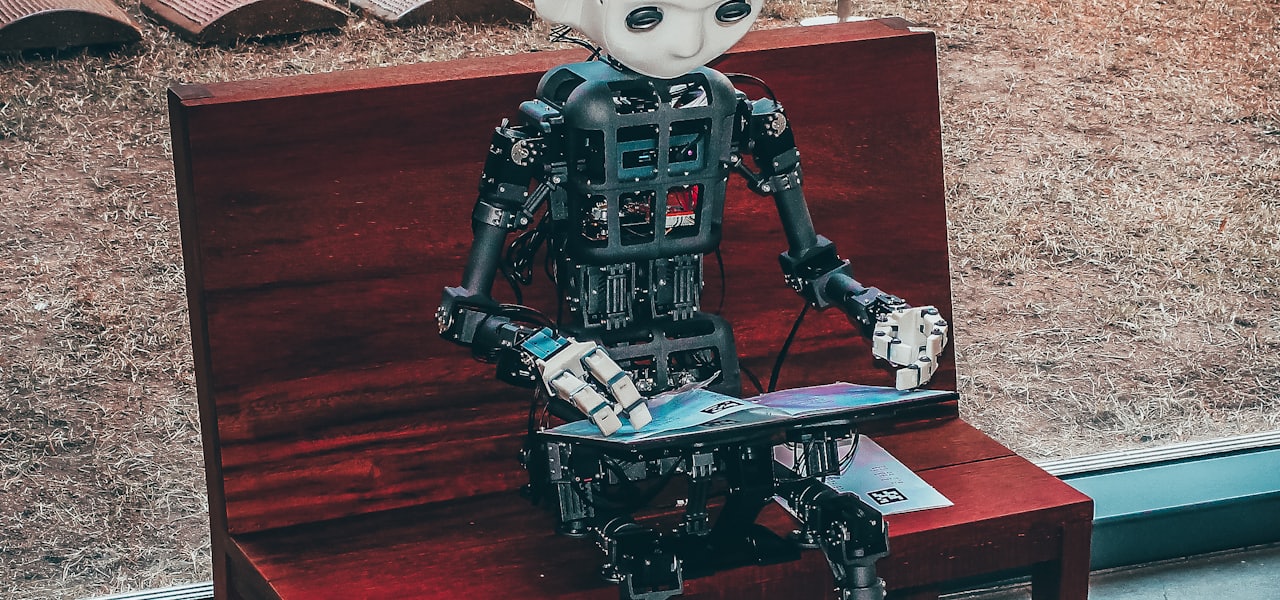
Anthrobotics is the science of developing and studying robots that are either entirely or in some way human-like. The term anthrobotics was originally coined by Mark Rosheim in a paper entitled "Design of An Omnidirectional Arm" presented at the IEEE International Conference on Robotics and Automation, May 13–18, 1990, pp. 2162–2167. Rosheim says he derived the term from "...Anthropomorphic and Robotics to distinguish the new generation of dexterous robots from its simple industrial robot forebears." The word gained wider recognition as a result of its use in the title of Rosheim's subsequent book Robot Evolution: The Development of Anthrobotics, which focussed on facsimiles of human physical and psychological skills and attributes. However, a wider definition of the term anthrobotics has been proposed, in which the meaning is derived from anthropology rather than anthropomorphic. This usage includes robots that respond to input in a human-like fashion, rather than simply mimicking human actions, thus theoretically being able to respond more flexibly or to adapt to unforeseen circumstances. This expanded definition also encompasses robots that are situated in social environments with the ability to respond to those environments appropriately, such as insect robots, robotic pets, and the like. Anthrobotics is now taught at some universities, encouraging students not only to design and build robots for environments beyond current industrial applications, but also to speculate on the future of robotics that are embedded in the world at large, as mobile phones and computers are today. In 2016 philosopher Luis de Miranda created the Anthrobotics Cluster at the University of Edinburgh "a platform of cross-disciplinary research that seeks to investigate some of the biggest questions that will need to be answered" on the relationship between humans, robots and intelligent systems and "a think tank on the social spread of robotics, and also how automation is part of the definition of what humans have always been". to explore the symbiotic relationship between humans and automated protocols.
Multiple buffering
In computer science, multiple buffering is the use of more than one buffer to hold a block of data, so that a "reader" will see a complete (though perhaps old) version of the data instead of a partially updated version of the data being created by a "writer". It is very commonly used for computer display images. It is also used to avoid the need to use dual-ported RAM (DPRAM) when the readers and writers are different devices. == Description == === Double buffering Petri net === The Petri net in the illustration shows double buffering. Transitions W1 and W2 represent writing to buffer 1 and 2 respectively while R1 and R2 represent reading from buffer 1 and 2 respectively. At the beginning, only the transition W1 is enabled. After W1 fires, R1 and W2 are both enabled and can proceed in parallel. When they finish, R2 and W1 proceed in parallel and so on. After the initial transient where W1 fires alone, this system is periodic and the transitions are enabled – always in pairs (R1 with W2 and R2 with W1 respectively). == Double buffering in computer graphics == In computer graphics, double buffering is a technique for drawing graphics that shows less stutter, tearing, and other artifacts. It is difficult for a program to draw a display so that pixels do not change more than once. For instance, when updating a page of text, it is much easier to clear the entire page and then draw the letters than to somehow erase only the pixels that are used in old letters but not in new ones. However, this intermediate image is seen by the user as flickering. In addition, computer monitors constantly redraw the visible video page (traditionally at around 60 times a second), so even a perfect update may be visible momentarily as a horizontal divider between the "new" image and the un-redrawn "old" image, known as tearing. === Software double buffering === A software implementation of double buffering has all drawing operations store their results in some region of system RAM; any such region is often called a "back buffer". When all drawing operations are considered complete, the whole region (or only the changed portion) is copied into the video RAM (the "front buffer"); this copying is usually synchronized with the monitor's raster beam in order to avoid tearing. Software implementations of double buffering necessarily require more memory and CPU time than single buffering because of the system memory allocated for the back buffer, the time for the copy operation, and the time waiting for synchronization. Compositing window managers often combine the "copying" operation with "compositing" used to position windows, transform them with scale or warping effects, and make portions transparent. Thus, the "front buffer" may contain only the composite image seen on the screen, while there is a different "back buffer" for every window containing the non-composited image of the entire window contents. === Page flipping === In the page-flip method, instead of copying the data, both buffers are capable of being displayed. At any one time, one buffer is actively being displayed by the monitor, while the other, background buffer is being drawn. When the background buffer is complete, the roles of the two are switched. The page-flip is typically accomplished by modifying a hardware register in the video display controller—the value of a pointer to the beginning of the display data in the video memory. The page-flip is much faster than copying the data and can guarantee that tearing will not be seen as long as the pages are switched over during the monitor's vertical blanking interval—the blank period when no video data is being drawn. The currently active and visible buffer is called the front buffer, while the background page is called the back buffer. == Triple buffering == In computer graphics, triple buffering is similar to double buffering but can provide improved performance. In double buffering, the program must wait until the finished drawing is copied or swapped before starting the next drawing. This waiting period could be several milliseconds during which neither buffer can be touched. In triple buffering, the program has two back buffers and can immediately start drawing in the one that is not involved in such copying. The third buffer, the front buffer, is read by the graphics card to display the image on the monitor. Once the image has been sent to the monitor, the front buffer is flipped with (or copied from) the back buffer holding the most recent complete image. Since one of the back buffers is always complete, the graphics card never has to wait for the software to complete. Consequently, the software and the graphics card are completely independent and can run at their own pace. Finally, the displayed image was started without waiting for synchronization and thus with minimum lag. Due to the software algorithm not polling the graphics hardware for monitor refresh events, the algorithm may continuously draw additional frames as fast as the hardware can render them. For frames that are completed much faster than interval between refreshes, it is possible to replace a back buffers' frames with newer iterations multiple times before copying. This means frames may be written to the back buffer that are never used at all before being overwritten by successive frames. Nvidia has implemented this method under the name "Fast Sync". An alternative method sometimes referred to as triple buffering is a swap chain three buffers long. After the program has drawn both back buffers, it waits until the first one is placed on the screen, before drawing another back buffer (i.e. it is a 3-long first in, first out queue). Most Windows games seem to refer to this method when enabling triple buffering. == Quad buffering == The term quad buffering is the use of double buffering for each of the left and right eye images in stereoscopic implementations, thus four buffers total (if triple buffering was used then there would be six buffers). The command to swap or copy the buffer typically applies to both pairs at once, so at no time does one eye see an older image than the other eye. Quad buffering requires special support in the graphics card drivers which is disabled for most consumer cards. AMD's Radeon HD 6000 Series and newer support it. 3D standards like OpenGL and Direct3D support quad buffering. == Double buffering for DMA == The term double buffering is used for copying data between two buffers for direct memory access (DMA) transfers, not for enhancing performance, but to meet specific addressing requirements of a device (particularly 32-bit devices on systems with wider addressing provided via Physical Address Extension). Windows device drivers are a place where the term "double buffering" is likely to be used. Linux and BSD source code calls these "bounce buffers". Some programmers try to avoid this kind of double buffering with zero-copy techniques. == Other uses == Double buffering is also used as a technique to facilitate interlacing or deinterlacing of video signals.
H (company)
H Company, also known simply as H, is a French artificial intelligence startup which develops "action-oriented" artificial intelligence agents for enterprise automation and productivity. In May 2024, H Company closed a record-setting $220 million seed round, at the time the largest AI raise in Europe. In 2026, H Company released Holo 3, the latest generation of its computer-use AI models. The update marked a major advance in agentic AI, enabling agents to navigate any user interface, interpret screens, and complete complex, multi-step tasks across enterprise systems—much like a human user. This breakthrough positioned H Company at the frontier of computer-use autonomy, accelerating the integration of AI in enterprise workflows. == History == H Company was founded in 2023 in Paris by Laurent Sifre, Charles Kantor, and three DeepMind veterans: Daan Wiestra, Karl Tuyls, Julien Perollat. In May 2024, the firm secured what was then the largest European AI seed round, totaling $220 million led by US investors including Eric Schmidt (former Google CEO), Amazon, and backed by Accel, Bpifrance, UiPath, Eurazeo, Xavier Niel, Yuri Milner, Bernard Arnault, Samsung and others. In August 2024, three cofounders (Wiestra, Tuyls, Perollat) left the company over operational disagreements. In November 2024, H launched Runner H, its first agentic-API platform, which combined a large language model (LLM) and a reduced, 2-billion parameter vision-language model (VLM). In May 2025, H Company acquired Mithril Security, and in June 2025 the company widened its offering for agentic models. In June 2025, Gautier Cloix (formerly CEO Palantir France) replaced Charles Kantor as CEO of H Company, aiming to pivot the company towards a "forward deployed engineers" model. In July 2025, H Company introduced Surfer-H-CLI, an open-source, web-native Chrome agent designed for browser-based automation—able to search, scroll, click, and type on behalf of users and controllable via any visual language model (VLM). When paired with its June 2025 open-sourced 3B-parameter Holo-1 model, Surfer-H-CLI achieved 92.2% WebVoyager benchmark accuracy. == Activity == H Company creates enterprise AI models and agents (agentic AI) to automate and optimize complex workflows. H Company specifically designs AI agents called computer use capable of autonomously interfacing with any software (local or cloud-based) to detect and automate repetitive operations. H Company is based in Paris, France, with international offices in London and New York. H Company raised $220 million since its inception. Gautier Cloix is president and CEO of the company. H Company client include the French national lottery FDJ United. In March 2026, H Company released Holo3, a family of artificial intelligence models designed to operate digital systems by interacting directly with user interfaces. Holo3 enables agents ("virtual humanoids") to understand what is displayed in front-end environments—such as web pages, desktop applications, and other graphical user interfaces—and perform actions such as clicking, typing, and navigating across them to complete multi-step tasks. On the OSWorld-Verified benchmark, Holo3 reportedly achieved about 78.9%, surpassing the scores of OpenAI’s GPT‑5.4 and Anthropic’s Claude Opus 4.6 on this specific test, at roughly one-tenth of the inference cost of these proprietary systems. The release has been presented as a significant step toward automating routine digital workflows, allowing organizations to offload repetitive on-screen work, such as data entry and reconciliation across multiple tools, to AI-based agents.
VideoThang
VideoThang was free video editing software for Windows 2000, XP, and Vista. The software has three parts to it which are My Stuff, Edit My Stuff, and My Mix. The software accepts MOV, AVI, MPG, MP4, PNG, WMV, FLV, and MP3 standards. Its official website is now no longer available. == Reception == Jan Ozer, of Pcmag, said that the software "suffers from several unfortunate design and implementation flaws that dramatically limit output quality and overall utility." Jon L. Jacobi, of PC World, said that the software "may not be the most flexible multimedia editor in the world, but the trim/zoom basics are there, it's free, and it's so simple to use that just about anyone in the world should be able figure it out." Amit Agarwal, of Digital Inspiration, said that the software "doesn’t offer loads of features like other video editors but is perfect for making quick video slideshows of your pictures that you can upload on the web or share via email."